






Italian wine tasting samples - March 2013.
Positives
God gave us the vine and the grape, we made wine. Making good wine is a skill, making fine wine an art.








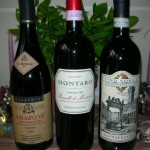 I have recently conducted a series of wine tasting sessions of various wine samples supplied by Casavini of Fgura, from their imported stock. I have already published a feature of wines from this importer, this time from the Terre di Vino range in our sister website, Reno Spiteri’s Wineopolis , which can be logged in through the “Wineopolis” link given at the top menu bar of this website. If you have not read those reviews as yet, just click on the link and you’re logged in instantly. The following are my findings and conclusions of the recent tastings:
Vinosia ue passule DOC 2009.
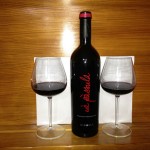 An exceptional 100% Primitivo wine produced from over 70 years-old vines consequently producing low grape yields. This wine is produced by Luciano and Mario Ercolino, the former winemakers at “Feudi di San Gregorio” of Campania.
The wine is matured in French barriques. It has a very dark ruby-red color (almost black), aromas of blackberry, plum, clove, cinnamon and a subtle oak touch. The palate reveals a full-bodied but absolutely harmonious and elegant wine, dominated by rich and tasty fruit components, with a wonderful balance, good structure and a perfectly integrated acidity. Lingering finish.
Can be further aged in ideal cellar conditions. Must be opened and decanted about one hour before drinking for optimum enjoyment.
Grape: 100% Primitivo, grown in limey-clay soil, handpicked and harvested in mid-September.
VINIFICATION PROCESS: Maceration for about 7 days, fermentation partially carried out using an auto-chthonous yeast starter, fermentation completed in French oak after which it is refined in French wooden casks and barriques.
Alcohol content:
Serving Temperature: 18 - 20 deg.C.
RATING: RS92.
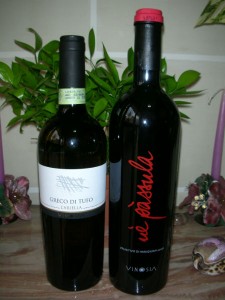
GRECO DI TUFO DOCG L’Ariella 2011.
 GRAPE VARIETY: 100% Greco di Tufo
SOIL TYPE: The soils to be found to the northwest of the villages of Tufo, Chianche and Altavilla Irpinia are interesting as they are derived from the decomposition of clay based rocks over thousands of years and so are highly rich in calcium. The unique characteristics of the soil in the region give the wine its perfume and complexity.
THE Greco di Tufo VINE was first taken to Italy by the Greek colonialists of VII/VIII B.C. It derives from ‘Aminea Gemella’ described in the Georgics and cultivated on the slopes of Vesuvius. The name ‘gemella’ derives from the presence of winged clusters of fruit, a characteristic of this vine. In the more recent past due to its great aromatic heritage this vine was confused with the Italian Reisling. Today it represents one of the strongest expressions of the national viticulture heritage in light of its intense aromatic and mineral fragrance, noted also for its longevity.
HARVEST: The last ten days of October, selected in vineyard and handpicked.
VINIFICATION PROCESS: Light pressing of whole cluster, cold static clearing, fermentation is partially carried out using autochthonous yeast starter.
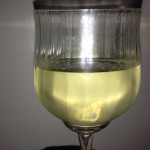 CHARACTERISTICS: The soil of Greco, which is rich in sulphur and calcium give the grapes an intense aromatic and mineral fragrance which is a distinctive characteristic of the great white wines of the area. The wine has a clear, straw yellow colour. Aromas of citrus fruits, fresh with a distinct acidity. In the mouth it is crispy and refreshing with hints of mineral and grapefruit. Medium-bodied, medium finish.
Alcohol content: 13%
Serving temperature: 10 to 12 Deg C.
Rating: RS88
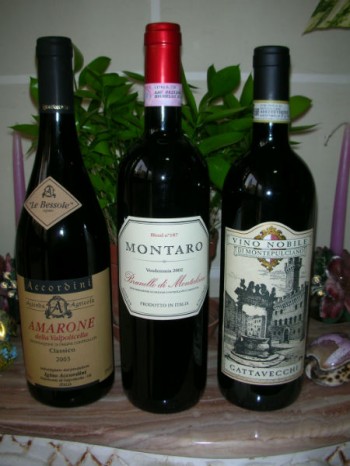
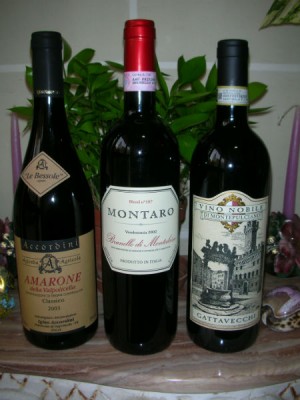
Accordini Le Bessole Amarone DOC 2003.
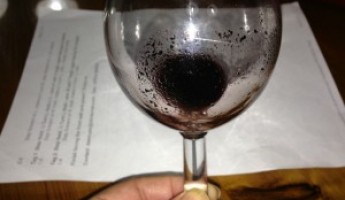
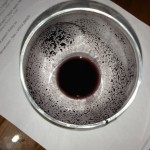
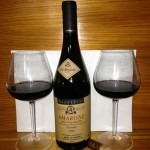 This wine has a dense “rusty-cherry” colour that shows that it has aged nicely. Significant sediment in bottle, and it is important to rest it upright before pouring, or better yet, decant a half hour before serving.
On the nose it has matured into something more of a rich port wine. On the palate it is rich with the flavours of blackberry, prunes and fresh pears, liquorice, , almond and orange rind. A well structured and integrated wine, complex yet elegant. Fine and velvety tannins, dry with a long finish.
Best to drink now as it appears to have reached its peak.

 The grapes:This wine is produced from 70% Corvina, 20% Rondinella, 10% Corvinoni/Molinara – selection of the best grapes from individual bunches in the premier cru region. The grapes are generally harvested in the first two weeks of October. They are laid on racks in single layers to allow a better air circulation. The grapes start to dry out on the fruit and on average, after 120 days, they loose 45% of their weight. Throughout this period of time the grapes are checked on a regular basis and any damaged clusters are removed. The grapes are vinified end of February with a long maceration on the skins until the wine reaches an alcohol content of at least 15%. The wine is then refined in kegs before being transferred into barrels. The wine is bottled about 3 years later and further aged in the bottle before releasing.
Alcohol content: 15%
Serving temperatur: 18 Deg. C.
Rating: RS93
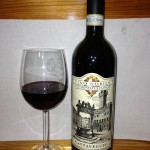
Gattavecchi Vino Nobile de Montepulciano DOCG 2009.
 PRODUCTION AREA: Montepulciano: Argiano and Ascianello.
GRAPE VARIETIES: Sangiovese (Prugnolo) 90% - blend of native red grapes 10%.
SOIL: Mixtures of clay and fine sand with Marine Pliocene sediment.
MICROCLIMATE: Moderate temperatures throughout the year create favourable microclimatic conditions. In addition, the proximity of Lakes Montepulciano, Chiusi and Trasimeno, and Mount Amiata, has a positive effect on the local climate.
VINIFICATION AND REFINING: After careful stalk removal and pressing, the grapes undergo a slow maceration that lasts 16 – 18 days at a controlled temperature that doesn’t exceed 28°C. During this stage, pump-overs are carried out several times a day, diminishing as fermentation winds down. Malolactic fermentation occurs naturally during the month of December. The wine is aged for two years in medium sized Slavonian oak casks, and small French oak barrels. This is followed by a six-month period of refinement in the bottle.
CHARACTERISTICS: The colour is deep garnet with the rim fading to orange. The wine looks older than it actually is. The bouquet is delicate , rich and penetrating, with hints of mature plum. In the mouth the flavour is dry, warm and robust, with lively cherry fruit and greenish peach overtones, supported by smooth tannins. It is the perfect accompaniment for red meats, game and well-seasoned cheeses. Best opened at least two hours before serving or decanted. Long. pleasing finish.
Alcohol content: 13.5%
Serving Temperature: 18 – 20C
Rating: RS90
Brigante Cantine Orsogna IGT 2011.
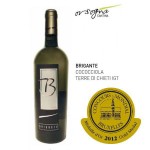 Main characteristics and style: Color white; modern styled, fresh wine. Full-bodied, produced by Cantina Orsogna form 100% Cocciola grapes.
Cococciola is a white Italian wine grape variety that is was one of the few Italian grape varieties to have its number of plantings increase in the late 20th century while measures to combat Europe’s wine lake and the general decline of viticulture saw the numbers of many varieties decline. Today Cococciola is a permitted variety in the Trebbiano d’Abruzzo Denominazione di origine controllata (DOC) from the Abruzzo region of central Italy.
The wine has a very rich golden yellow colour. In the mouth it is crispy, fresh with hints of citrus fruit, lemon, lime and grapefruit. In the mouth it is refreshing with smooth acidity.
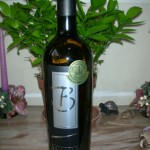
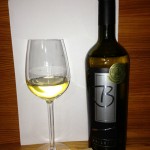 Excellent with white fish and seafood.
This vintage has won the Gold medal at the Concours Mondial in Brussels 2012.
Alcohol content: 13%
Serving temperature: Chilled to 10deg.C.
Rating: RS89.
Ratings are based on a standard points formulae given for typical headings of: colour, aroma and bouquet, flavour and finish, and overall quality level and potential. Each of these heading has a different points weighting.

